Welcome to Yamada group
JST-ASPIRE Programme
Kaylin Lamaute-san from Pennsylvania State University visited us.
JSPS-Summer Programme
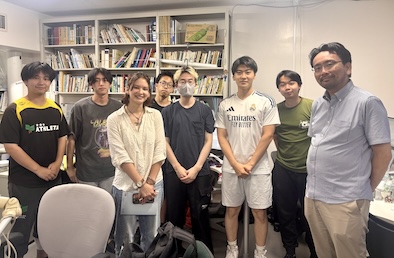
Erdogan Kasisari-san from University of Freiburg visited us and conducted experiments for two months.
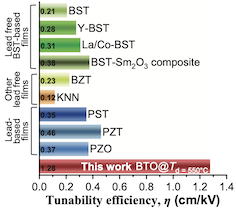
Published: Low-field Giant Dielectric Tunability in PLD-nanocrystalline/Amorphous Composite BTO Thin Films
Our paper entitled “Low-Field Giant Dielectric Tunability by Polaron-Mediated Interfacial Polarization in Pulsed-Laser-Deposited-Nanocrystalline/Amorphous composite BaTiO3 Thin Films” has been published in Adv. Electron. Mater. BaTiO3 thin films grown under vacuum show giant dielectric tunability at low electric fields due to oxygen-vacancy-induced polaron-mediated interfacial polarization. The films achieve a dielectric constant above 3000 and a record tunability efficiency, enabling high-performance low-voltage tunable dielectric devices.
Seminar: Prof. My Ali El Khakani
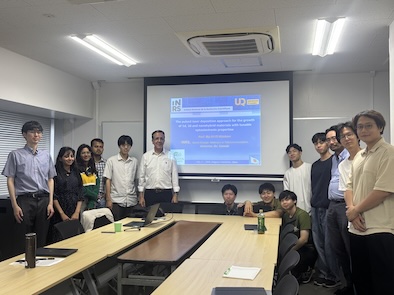
On Jul. 1, Prof. My Ali El Khakani (INRS, Canada) visited us and lectured on material synthesis using PLD.
Lecturer: Prof. My Ali El Khakani (INRS, Canada)
The Pulsed Laser Deposition Approach for the Growth of 1d, 2d and Nanohybrid Materials with Tunable Optoelectronic Properties
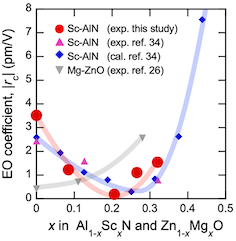
Published: Nonmonotonic Enhancement of EO Properties in AlScN Films
Our paper entitled “Nonmonotonic Enhancement of Electro-optic Properties of Wurtzite AlN Thin Films by Sc Doping” has been published in Adv. Electron. Mater. We demonstrated the nonmonotonic enhancement of EO response in AlScN films with increasing Sc content up to 32%, which suggests that further increases in Sc content may yield EO response comparable to or even superior to that of LiNbO3, a present representative EO material.
JST-ASPIRE Programme
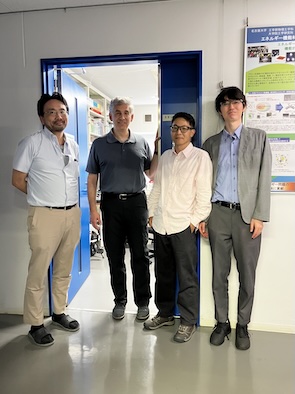
On June 10, Prof. Andrew Rappe (University of Pennsylvania) visited us.
JST-LOTUS Programme
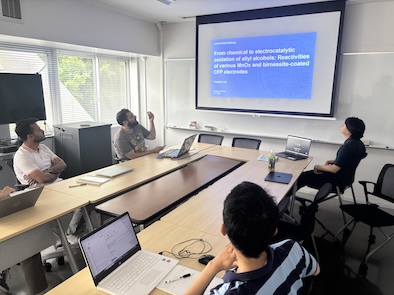
Prof. Mahesh Peddigari (IIT Hyderabad, India) visited us and lectured on energy storage applications using ferroelectrics.
Lecturer: Prof. Mahesh Peddigari (IIT Hyderabad, India)
Aerosol Deposited Dielectric Ceramic Thick Films for Energy Storage Applications
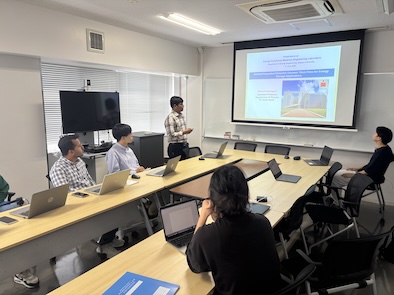
JST-ASPIRE Programme
Niklas Kyoushi-san from University of Kiel visited us and conducted experiments over a period of two weeks.
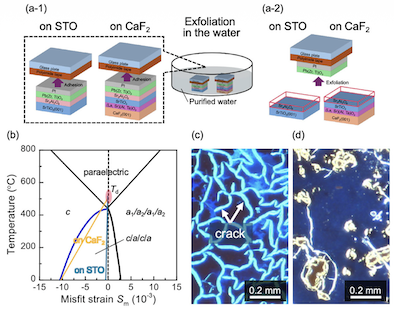
Published: Large-area Release of PZT Films with Reduced Crack Generation via Ferroelastic Domain Engineering
Our paper entitled “Large-area Release of Pb(Zr, Ti)O3 Films with Reduced Crack Generation via Ferroelastic Domain Engineering” has been published in Small Struct. We demonstrated an approach for producing 200 nm-thick freestanding PZT membranes with reduced crack generation by achieving a single c-domain structure through ferroelastic domain engineering.