Mizuki ISHIDA won the presentation award of The 44th Electronics Division Meeting of the Ceramic Society of Japan held in Keio University, Japan for his presentation on doped pyrochlore dielectric materials.

Department of Energy Engineering, Nagoya University
Mizuki ISHIDA won the presentation award of The 44th Electronics Division Meeting of the Ceramic Society of Japan held in Keio University, Japan for his presentation on doped pyrochlore dielectric materials.
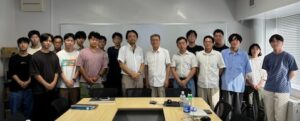
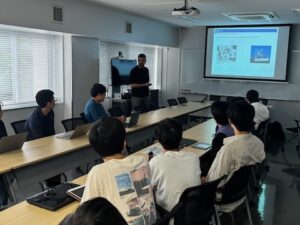
On Jul. 18, Prof. Guorong Li (Shanghai Institute of Ceramics) visited us and lectured on high-entropy ferroelectric ceramics. In addition, Dr. Lei Meng and Dr. Xueyou Yuan gave their seminars.
1) Fabrication and Properties of ABO3 Ferroelectric Ceramics with A- and B-site disorder for high-energy storage (Prof. Guorong Li)
2) Strong Second-order Nonlinear-polarization in Widegap ZnMgO Thin-films with Li Incorporation (Dr. Lei Meng)
3) Extraordinarily Large Extrinsic Contribution Ratio to Piezo-response in Monoclinic (K, Na)NbO3 Epitaxial Films (Dr. Xueyou Yuan)
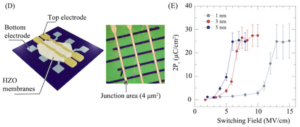
Our collaborative paper with Kyoto University entitled “Ferroelectric Freestanding Hafnia Membranes with Metastable Rhombohedral Structure down to 1-nm-thick” has been published in Nat. Commun. We fabricated stable 1-nm-thick hafnia membranes exhibiting the metastable rhombohedral structure and out-of-plane ferroelectric polarizations as large as 13 μC/cm2.
Citation: Nat. Commun. 15, 1055196 (2024).
On Jun. 6, Dr. Alexandros Emborasa (ETH Zurich) visited us and lectured on neuromorphic computing.
Lecturer: Dr. Alexandros Emborasa (ETH Zurich)
Seminar title: Neuromorphic Computing: From Devices to Applications
Our paper entitled “Novel Route for Enhancing Piezoelectricity of Ferroelectric Films: Controlling Nontrivial Polarization States in Pb(Zr, Ti)O3 Monodomain Superlattice Structure” has been published in ACS Appl. Mater. Interfaces. We found that (111)-epitaxial artificial superlattice thin films consisting of Pb(Zr0.4Ti0.6)O3 and Pb(Zr0.6Ti0.4)O3 can be stabilized into unique monodomain state, which results in the piezoelectric response larger than the typical clamped films with the same chemical compositions.
Citation: ACS Appl. Mater. Interfaces 16, 16145 (2024).
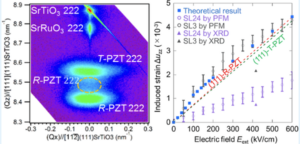
Our paper entitled “Extraordinarily Large Contribution Ratio of Ferroelastic Domain Switching to Piezoresponse in Monoclinic (K, Na)NbO3 Films” has been published in Adv. Electron. Mater. We found that the extrinsic contribution to the piezoresponse in (111)epitaxial monoclinic (K, Na)NbO3 films is extraordinarily large, over 100% under moderate electric fields.
Citation: Adv. Electron. Mater. 10, 2300405 (2024).
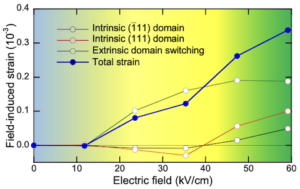
Our paper entitled “Dynamic Electrical Response of Vortex Polarization in (Pb0.9Sr0.1)TiO3/SrTiO3 Artificial Superlattice Thin Films” has been published in Appl. Phys. Lett. We found that the reorientation of dipole moments in the vortex domains is susceptible to the applied electric field pulses of 500 μs and is a reversible process. Although the centrosymmetric vortex domain structure is not considered to exhibit piezoelectricity, an evident change in the out-of-plane lattice constant with the applied electric field was revealed.
Citation: APL 121, 172904 (2022).
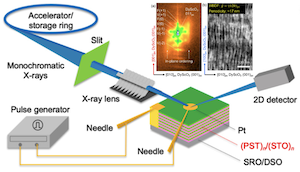
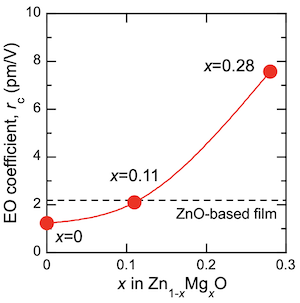
Our paper entitled “Strong Electro-optic Effect in Mg Incorporated ZnO Thin Films” has been published in Appl. Phys. Lett. We found that the Mg incorporation enhances the linear EO response significantly. In particular, the Zn0.72Mg0.28O thin film showed an effective EO coefficient of 7.6 pm/V, which is over three times larger than the reported values for ZnO-based thin films and over twice larger than that of ZnO single crystals. This study is the collaborative research with Dr. Meng of Institute of Semiconductors, Chinese Academy of Sciences.
Citation: APL 121, 152903 (2022).
Our paper entitled “Effect of Ni Doping on the Electro-optic Property in K(Ta0.6Nb0.4)O3 Films” has been published in Jpn. J. Appl. Phys. We found that a larger withstand electric field was achieved by Ni doping, therefore, the variation of refractive index by the applicable maximum electric field was increased.
Citation: JJAP 61, SN1005 (2022).
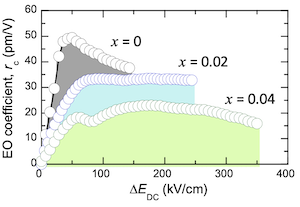
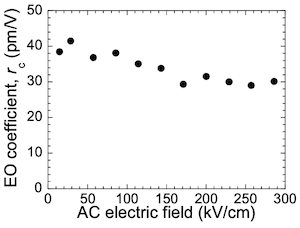
Our paper entitled “Optimizing the Growth of K(Ta0.6Nb0.4)O3 Films using Pulsed Laser Deposition and their Electro-optic Property” has been published in J. Ceram. Soc. Jpn. We revealed that the optimized KTN film showed the maximum EO coefficient rc of 42 pm/V, which is larger than the previously reported value for KTN thin films having the same composition.
Citation: JCSJ 130, 424 (2022).