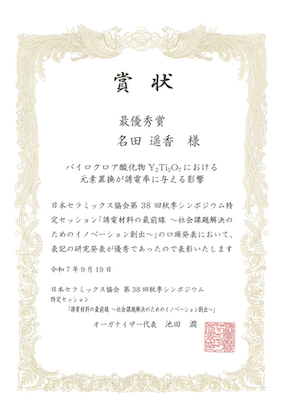
Haruka NADA won the grand prize of the dielectric materials session in The 38th Fall Meeting of the Ceramic Society of Japan held in Gunma University, Japan for her presentation on doped Y2Ti2O7 dielectric thin films.

Energy Functional Materials Engineering Laboratory
Department of Energy Engineering, Nagoya University
Haruka NADA won the grand prize of the dielectric materials session in The 38th Fall Meeting of the Ceramic Society of Japan held in Gunma University, Japan for her presentation on doped Y2Ti2O7 dielectric thin films.
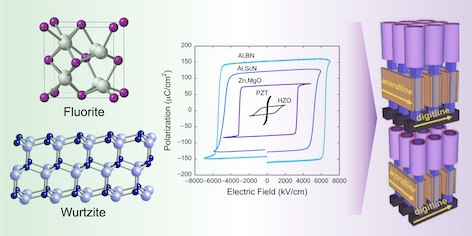
Our review paper entitled “A New Era of Ferroelectric Thin Films for Nonvolatile Memories” has been published in MRS Bull. This special issue comprises seven reviews (for theoretical and experimental studies), including this one.
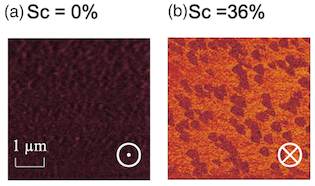
Our paper entitled “Effect of Sc Content on the Polarity of AlScN Thin Films Deposited on Indium Tin Oxide by Radio Frequency-magnetron Sputtering” has been published in Jpn. J. Appl. Phys. We found that the polarity is affected by both the degree of epitaxy and the amount of Sc content.
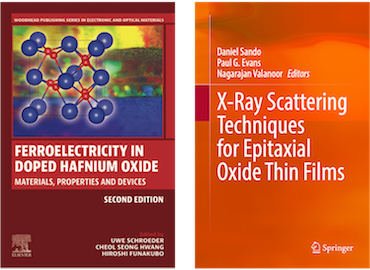
Our articles on Tunable Optical and Dielectric Properties of Ferroelectric Hafnia and Time-resolved XRD for Ferroelectric Films have been published as book chapters.
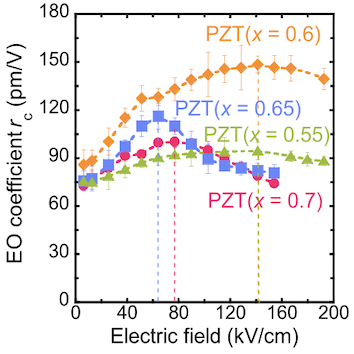
Our paper entitled “Composition Dependence of Electro-optic Effect in (111)/(11-1)-oriented Epitaxial Rhombohedral Pb(ZrxTi1−x)O3 Thin Films Prepared by Chemical Solution Deposition” has been published in Jpn. J. Appl. Phys. We found that the effective EO coefficient was not constant with respect to the applied field but varied with the magnitude of AC field due to dynamic domain motion, reaching its maximum value at a certain electric field.
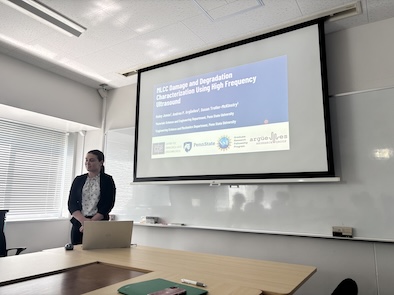
Haley Jones-san from Pennsylvania State University visited us and conducted research in our laboratory for three months.
Our paper entitled “Thickness Dependence of the Electro-optic Properties in Epitaxial Hf0.5Zr0.5O2 Thin Films: Evident Response Down to 3 nm” has been published in Appl. Phys. Lett. We found that although the effective EO coefficient, reff, remained almost unchanged down to 10 nm and decreased with a further decrease in thickness, the evident EO response was observed down to 3 nm, which agrees with the fact that HZO films can maintain ferroelectric properties down to a few monolayers in thickness. The small reff in the HZO films with thickness below 5 nm is attributed to the stabilization of the ferroelectric rhombohedral-like phase.

Our paper entitled “Distinct Roles of Mg and Li in Affecting the Electro-optic Properties of Wurtzite ZnO Thin Films” has been published in Appl. Phys. Lett. Increasing the Mg content in ZnO significantly enhances internal parameter u and reduces the anion–cation bond lengths along the c-axis direction. This facilitates Zn displacement along the c-axis direction and increases electric susceptibility, enhancing the ionic contribution to rc. As opposite to Mg, Li incorporation produces slight lattice expansion and increases anion–cation bond lengths along the c-axis orientation. Larger rc could be reached by optimizing the Mg and Li content as well as the thickness. These findings suggest the great potential of widegap ZnMgO:Li thin films for applications to EO modulation in ultraviolet band.

On April 30, Prof. Jong Eun Ryu (North Carolina State University) visited us and lectured on XPCS study of ferroelectric materials.
Lecturer: Prof. Jong Eun Ryu (North Carolina State University)
Investigating Domain Dynamics in Ferroelectric Materials Using In-Situ X-Ray Photon Correlation Spectroscopy
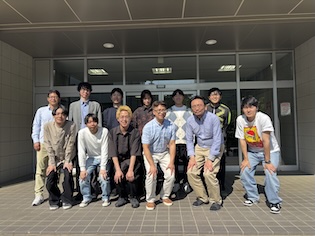
Dr. Shinya KONDO (assistant professor) and Dr. Kosuke ONO (research assistant professor) join us today.
Dr. Xueyou YUAN was promoted to a research lecturer. Congrats!